

This week’s post continues the line of thinking we began last week with the Rebbe’s letter to Kadish Luz. There, the emphasis was on the individual within the collective and how community must serve as a platform for the flourishing of the unique self. Now we will shift our emphasis from the individual's function and potential to their irreducible essence. The individual is not only valuable; they are indivisible. No matter how pressing the needs of the many, Jewish law draws a line: a single soul cannot be surrendered, absorbed, or treated as expendable.
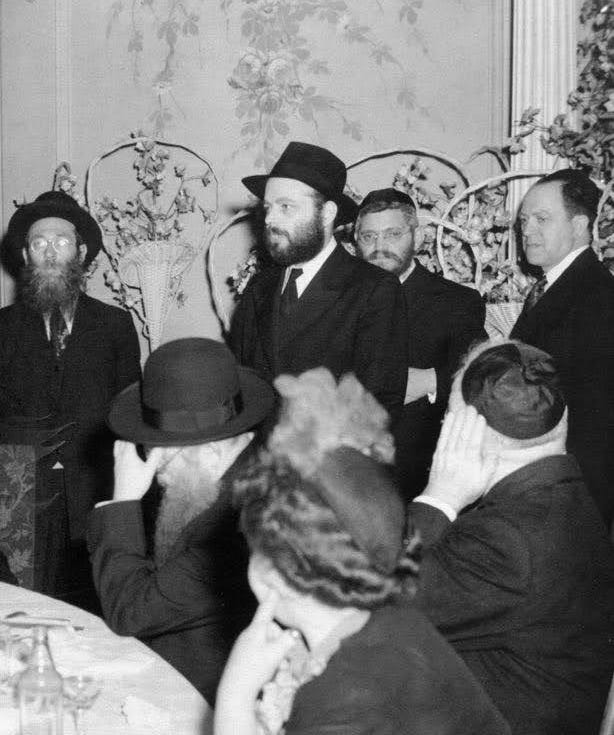
The text comes from a fascinating source: a speech the Rebbe intended to deliver at a wedding in 1944. However, the speech was never given. What remains is a terse set of handwritten notes preserved in the Rebbe’s private notebook which was later published with annotations that help decipher their compressed arguments. I have made use of those editorial notes in preparing the translation that follows.
Despite its fragmentary form, the piece is tightly argued and philosophically far-reaching. At its core, it is an extended reflection on a single Mishnah: “Therefore, every person must say: the world was created for my sake.” The Rebbe unpacks this principle across halakhic and mystical registers, showing how the absolute worth of a single individual shapes Jewish law and theology at their most radical edge.
What follows is a translation and adaptation of a portion of those 1944 notes.
1. “Therefore, man was created alone, to teach that whoever sustains one life from Israel is considered as if they sustained an entire world…Therefore, every individual must say: for my sake the world was created.” (Mishnah, Sanhedrin 4:5)
The implication is clear. Each person, at every time and in every place, must internalise the awareness that their value is equal to an entire world. This is not a statement about Adam the first man, who was literally alone in the world, but a teaching about every individual who fulfils their potential in full. As the Sages remind us (Mishnah, Avot 4:3) that no person is without significance, each has a role that only they can fulfil, in their own time and place.
This holds true even though people can be ranked on different levels, whether in wisdom, moral stature, or their social role. The Talmud (BT Horayot 13a) teaches a hierarchy for saving lives in certain scenarios: a sage takes precedence over a king, a king over a High Priest, and likewise in the case of returning lost objects we follow the same order of preference. Similarly, in the case of people drowning, Jewish law (Rema, Yoreh De’ah 252:8) instructs us to save the person of greater stature first.
Still, this prioritisation applies only in cases of shev ve’al ta’aseh (passive inaction.) If one can only save one person and not both, the law allows choosing one over another. But when it comes to kum va’aseh (active intervention) such as killing one person to save another, the ruling is categorical: “Who says your blood is redder?” (BT Pesachim 25b). One may not take another’s life to save their own, regardless of who holds greater social or spiritual standing.
This same principle holds not only in comparing individuals of varying stature, but also in the case of the individual versus the collective. The Jerusalem Talmud (Terumot 8:4) discusses the case where non-Jews demand that the community hand over one Jew to be killed or else they will all be killed. The law is: they must not hand anyone over. The only exception is if the attackers specify a particular individual, and even then, according to the Rambam (Yesodei HaTorah 5:5), they may only do so if the person is already deserving of the death penalty. And even then, the law concludes: “We do not instruct them to hand him over.”
Rabbi Yosef Karo in his Kesef Mishneh notes that even though there may be no rational explanation in such cases, since by refusing, the entire group could be killed, Jewish law nonetheless holds that they should all allows themselves to be killed rather than transgress and actively hand someone over to their death. This is not based on logic or utilitarian reasoning, but on an unequivocal tradition that rejects the active spilling of blood. There is no calculus of lives lost in such cases, because life, each life, is beyond calculation.
2. This seemingly irrational stance finds deeper explanation in the inner teachings of the Torah, which are called (Zohar 3:152a) the “soul” of the Torah, just as the revealed teachings are its “body.” According to the Arizal (Etz Chaim 42:1), the verse “You are children of the L-rd your G-d” (Deut. 14:1) means that in every Jewish soul there is a divine spark of the Creator which becomes invested within the soul’s innermost essence, the yechidah. This yechidah is the source of all other soul faculties: nefesh, ruach, neshamah, and chayah.
And from this divine point within the soul, no hierarchy can be drawn. Differences among Jews exist on the level of intellect, emotion, or action. But on the level of essence, especially the divine spark itself, there are no gradations. And not only is there no greater or lesser, there is no distinction between individual and collective. One cannot speak of more or less “divine” any more than one can say that one breath of life is “more alive” than another.
The Talmud (BT Yoma 80b) illustrates this when it explains how the volume of food equivalent to a date can settle the mind of both a giant and a newborn. This measure is not based on body size but on the point at which awareness returns, and at that minimal threshold of life there are no distinctions.
3. Nevertheless, halakhah does at times follow the principle of “majority rules”, even in capital cases (acharei rabbim lehatot). This is because the Torah descends into the realm of reason and legal structure, and within reason there are indeed distinctions, between wise and simple, between majority and minority.
Still, there are domains where even these distinctions dissolve. The law that forbids handing over one life to save many, even when rational calculation might demand it, reflects a deeper commitment to the equal and absolute worth of every individual soul.
In other words, Torah law integrates both: it applies structure, reason, and hierarchy where appropriate, but it deliberately preserves legal spaces where none of those apply, in order to express the indivisibility of the soul. The divine spark in the Jew cannot be outweighed, even by an entire community.
A parallel can be drawn from an unrelated halakhic area: the laws of eiruv. When establishing a shared boundary for carrying on Shabbat, one must leave one courtyard without an eiruv to make carrying permissible for the rest. (Mishnah, Eiruvin 5:6) So too here: even though halakhah engages with the world of reason and structure, it must preserve a legal category where none of that holds sway in order to uphold the absolute dignity of the soul.
4. At a deeper level, we may go further. The divine spark within the soul is not only indivisible, but irreducible. Its presence is so whole, even in the “lowest” Jew, that it cannot be erased: not by a group, not by a hierarchy, not by any external calculation. The Tanya (ch. 19) explains that even in one who appears far from Jewish life, the spark remains whole. It may be dormant, but when awakened, especially in matters of faith or existential risk, it rises to the surface and animates the entire self.
So too here: when the question is whether to surrender a single life to save others, it touches the very root of that person’s being. And once we reach that level, distinctions no longer apply. Great or small, alone or among many, none of it matters. There can be no act of erasure.
5. This is also one of the fundamental differences between the Jewish people and the nations of the world, a difference made starkly visible in the present war.
Among the nations, especially those shaped by fascist ideology, the individual is nothing. The state or leader is everything. The individual exists to serve the collective, and may be discarded in its name.
Among Jews, the opposite is true. The individual is not subsumed by the collective, and even the ruling power is bound by law. A sage takes precedence over a king, indicating a subtle undermining of the importance of dominant state power, and a Jewish monarch, representing the highest authority, is obligated to act with justice and restraint. As the Shulchan Aruch HaRav (Hilchot Gezeilah u’Geneivah 19) rules, the king may not treat people unequally or favour one individual over another.
Here too, the sanctity of the individual is central.
6. Halakhah identifies specific cases where an item retains its identity, even when mixed with others, what the Talmud refers to as not being batel (not being subsumed or overridden). This applies, for example, to something of distinguished origin (such as a firstborn animal), something of notable quality (a piece fit to be served at a royal table), or something that is counted individually rather than by weight or volume. (BT Chulin 100a; BT Beitzah 3b)
These are all examples where the Sages ruled that the item cannot be disregarded within the mixture. Still, on a Torah level, even these items would technically be overridden by a majority and they remain distinct only by rabbinic decree.
There is one exception: the principle of kavua (something fixed in place.) When an item retains its distinct position and is not blended into a larger whole, it is never overridden, even by the Torah’s own standard of majority. Its identity remains intact and decisive. This is the one case where halakhah recognises an absolute that cannot be absorbed, dismissed, or made secondary. (BT Zevachim 73b)
That is the model for the Jewish soul. The divine spark is not only unquantifiable, it is fixed, absolute, and unyielding. It cannot be overridden, not even for the sake of the many.