

This essay was first published on 3 Tevet 5710 (23 December 1949) in HaTzofeh, at a moment when Jewish sovereignty in the Land of Israel had only just re-entered history.
Rabbi Chein’s central insight is that the struggle between Greece and Israel was not merely a clash of power. Two visions of humanity and history confronted one another, each animated by its own light. Chanukah, in this telling, is not a celebration of military success but of a different kind of triumph altogether: the victory of intrinsic light over borrowed illumination, of a flame fed by its own oil rather than by foreign sources.
Political independence, Rabbi Chein insists, does not guarantee spiritual authenticity. The danger is no longer that Jews will be extinguished by others, but that they will illuminate their lives, homes, and institutions with foreign lights. Chanukah thus becomes not only a memory of resistance, but a recurring demand: to ask whether the light we kindle is sealed by our own inner sources, or merely reflects the glow of someone else’s fire.
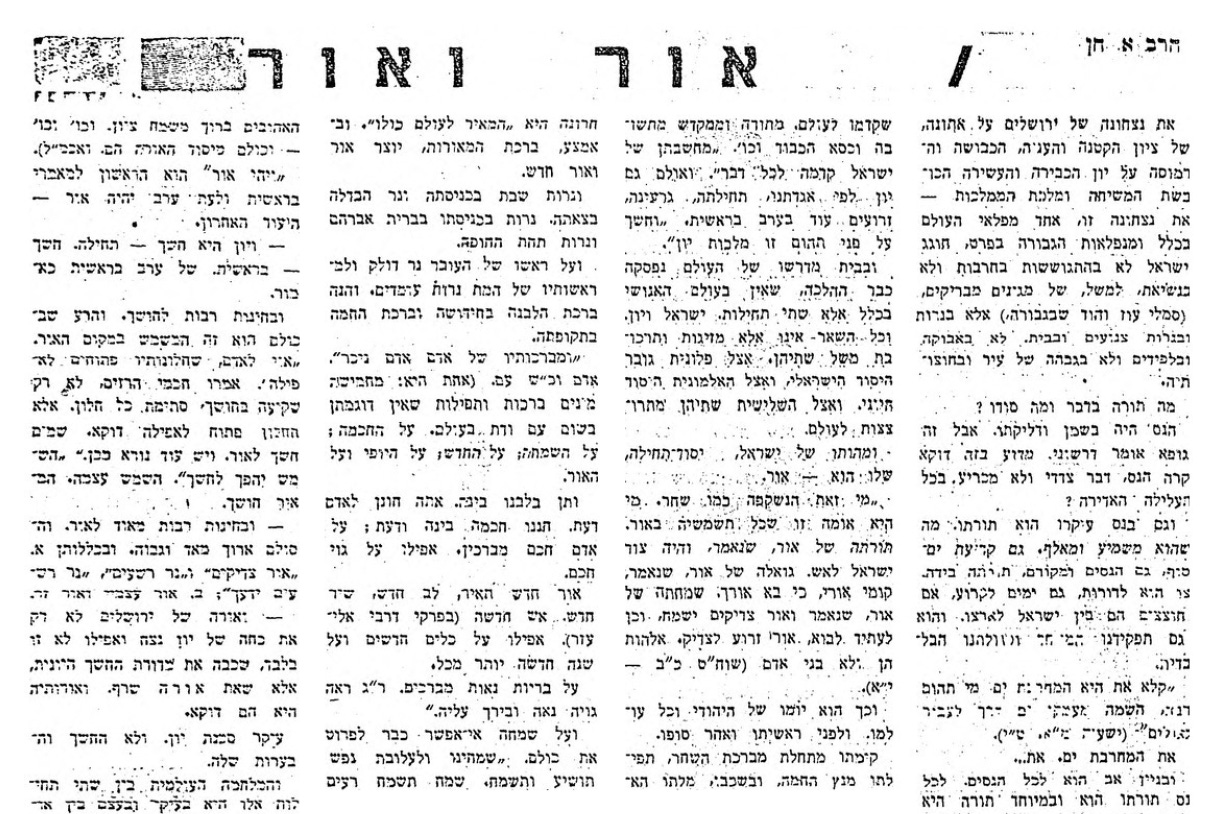
Israel celebrates the victory of Jerusalem over Athens, of small and impoverished Zion over mighty and wealthy Greece, not through the clashing of swords and not by bearing gleaming shields. It celebrates this wonder of history and marvel of heroism with flames. Quiet flames, kindled in the home. Not with torches and flares, and not in the public squares or upon the city heights.
The miracle of Chanukah, we are told, lay in the discovery of one pure jug of oil and in its burning for eight days. But why should the miracle be found here and not in the vast and dramatic unfolding of events? In something seemingly peripheral and not in the war, revolt and decisive victory?
Every miracle, at its core, is a teaching. It speaks. It instructs. And the miracle of the lights is no exception. Indeed, it is especially so.
What is this meant to teach us? What is its hidden meaning?
Israel’s victory, in its essence, is not a triumph of fist over fist. The eternal triumph of this people does not lie there.
The challenge was not rooted in Greek military prowess, nor was salvation sealed by Jewish courage. The secret of national revival and the restoration of sovereignty, then as now, does not lie in force.
Antiochus did not set out, from the beginning, to destroy a people or seize a land. His assault was aimed at the faith of Israel. Unlike the decree of Haman, his war was directed at the soul, not the body, as Chassidic teaching phrases it.
For this reason, the first vanguard of resistance was composed of the most soulful, people of inner life. The High Priest, servant of the Temple, became in an instant the first to raise a shield. The ascetic of the innermost sanctum transformed into a charging warrior. Linen vestments were exchanged for battle dress.
The Greek Challenge
Almost every campaign of religious persecution, in any time or place, is in fact only clothed in religious language. Its true motives lie elsewhere: in politics, power, economics, or social control. Religion serves merely as the pretext, not the cause.
The persecution of Israel by Antiochus, however, was different. It did not arise from circumstance or expedience, but from an existential confrontation of two worldviews. What he sensed in Judaism was not a rival creed but a rival vision of humanity and history, one that challenged the very foundations of the Greek worldview.
What Antiochus sensed, with a keen and almost instinctive perception, was something deeper: a secret that even many Jews themselves have not yet fully grasped. How in Israel, the beginning does not exhaust itself in abstract principles or ideal forms. It is distilled only in the final act. Meaning does not reside in the idea alone, but in its concrete fulfilment. ‘The end is rooted in the beginning,’ (Sefer Yetzirah 1:7) and precisely there in the end does the beginning reveal itself. In Judaism, thought and deed are not separable realms. ‘The taste of the tree and its fruit are the same.’ (BT Sukkah 35a)
There is a rule in history that one’s enemy often sees the core of one’s identity more clearly than one sees it oneself, and they directs their arrows and their poison toward it. For this reason, the nations have always identified the practice of Judaism and the Jew as one, never grasping or acknowledging one without the other.
Thus, when Greece struck at the religious practices of Israel, it struck at its very essence.
Primal Origins
There are two primal beginnings in human history: Israel and Greece. Of Israel’s precedence there is little need to speak. In Jewish thought, Israel precedes even the things that predate the world itself: Torah, the Temple, repentance, the Throne of Glory. ‘The thought of Israel preceded all.’ (Genesis Rabbah 1:4) Yet Greece too has its origin sown already on the eve of creation. ‘Darkness upon the face of the deep: this is the kingdom of Greece.’ (Genesis Rabbah 2:4)
It is widely acknowledged that human civilisation emerges from these two foundations: Israel and Greece. Everything else is a mixture, a compound drawn from both. In one culture the Israeli element predominates, in another the Greek, and in a third the two struggle endlessly.
The essence of Israel, as a primal beginning, is light.
‘Who is this that shines forth like the dawn?’ (Song of Songs 6:10) What is this nation whose every service is bound up with light? Its Torah is light: ‘The Rock of Israel shall be for a fire.’ (Isaiah 10:17) Its redemption is light: ‘Arise, shine, for your light has come.’ (Isaiah 60:10) Its joy is light: ‘The light of the righteous brings joy.’ (Proverbs 13:9) And in the future, ‘Light is sown for the righteous.’ (Psalms 97:11)
So it is with the day of the Jew and with their entire world, before its beginning and beyond its end.
They rise with the morning blessings, pray at sunrise, and when they lie down, their final words are ‘Who illumines the entire world.’ Between these moments stand the blessings over the luminaries, the Creator of light and the renewal of light.
Candles welcome the Sabbath and a candle marks its departure. Candles accompany entry into the covenant of Abraham and candles glow beneath the wedding canopy.
A candle burns above the head of the unborn child, and candles stand by the head of the dead. There is a blessing for the new moon and a blessing for the sun in its cycle.
‘A person is recognised by their blessings,’ (BT Berakhot 50a) and all the more so a people. There are blessings in Judaism unlike those of any other faith or nation: blessings for wisdom, for joy, for renewal, for beauty, and for light.
‘Grant us understanding.’ ‘You graciously endow humanity with knowledge.’ ‘Favour us with wisdom, understanding, and insight.’ A blessing is recited upon encountering a wise person, even a wise non-Jew.
Blessings over new vessels and over the new year more than over anything else.
Blessings are recited over beautiful creatures. Rabban Gamliel once saw a beautiful non-Jewish woman and blessed God. (JT Berakhot 9:1)
Blessings over joy are countless: ‘Gladden us,’ ‘Save and gladden the downtrodden soul,’ ‘Greatly gladden the beloved companions,’ ‘Blessed is He who gladdens Zion.’ All of them rooted in light.
‘Let there be light’ (Genesis 1:2) was the first utterance of creation, and ‘at evening time there shall be light’ (Zachariah 14:7) is the final promise of destiny.
Greece, by contrast, is darkness at the beginning. The primordial darkness of creation, the darkness of evening.
There are many forms of darkness, but the worst of them is that which masquerades as light. ‘Woe to the person whose windows are open to gloom,’ said the mystics. Not a sealed window, but one deliberately opened to darkness, calling darkness light. There is something more terrifying still: ‘The sun shall be turned into darkness.’ (Joel 3:4) The sun itself becoming an agent of obscurity.
There are also many kinds of light, and the ladder between them is long and steep. Broadly speaking, there is the light of the righteous and the lamp of the wicked, which is destined to be extinguished. (Proverbs 24:20) And then there is intrinsic light and borrowed light.
The light of Jerusalem did not merely overcome the power of Greece, nor did it only extinguish the Greek blaze of darkness. It burned up its lights.
This was Greece’s true danger. Not its ignorance or its darkness.
Conflicting Lights
The world-historical struggle between these two beginnings is, at its core, a struggle between their lights.
Here our argument truly begins, though time does not permit us to pursue it fully. We will content ourselves with a few familiar and accessible examples.
Consider Plato, the great luminary of Greece, whose light is sanctified by the world and revered even by many among Israel. In his lifelong masterwork, The Republic, he rules in favour of communal women, rigid class hierarchies culminating in masters and slaves, and the obligation to kill sick children, the elderly, and the infirm. This duty falls first upon parents and children themselves. This is the supreme ideal of the philosopher of ideas. This is the light of Greece.
Is there any need to recall the position of Judaism on these matters? Is it necessary to mention that the God of Israel hates licentiousness, that Jewish equality rises to the vision of ‘they shall no longer teach one another, for all shall know Me’? (Jeremiah 31:34) Not merely juridical or economic equality, but complete spiritual equality, without hierarchy. This is the Jewish destiny.
Most striking of all is the treatment of children and the vulnerable.
Against Greece’s lofty spiritual ideal stands the dry, prosaic halakhic ruling of Israel: ‘once the fetus has emerged to the brow, one may not take its life to save the mother.’ (Mishnah, Ohalot 7:6) This barely living piece of flesh possesses a right to existence equal to hers, even if she were Miriam or Deborah.
The suffering and downtrodden are precisely God’s chosen. ‘I dwell on high and holy, yet also with the crushed and humble,’ (Isaiah 57:15), and as the the Zohar says ‘The King’s dwelling is among broken vessels.’ (Zohar I:10a)
Foreign Lights
A great question remains. Why did the light of Judaism not conquer the world after its victory over Greece?
Even Moses grappled with this enigma at the first divine vision. ‘The bush burned with fire yet was not consumed (Exodus 2:3): Why do the thorns of the nations not extinguish the light of Israel, and why does the light of Israel not burn away the thorns of the nations?’ (Pirkei DeRebbi Eliezer 30)
The full resolution of this mystery may belong to the Messiah, but we have not even begun to tackle this problem. We have failed to polish and illuminate our own original lights of Torah and faith. We have not carried our lights to the nations. Too often, we ourselves have wandered after foreign lights, borrowed lamps, and darkened illumination.
Then came an eternal moment, when Israel in renewed Jerusalem, within the purified Temple, rekindled its own intrinsic light. The oil that fed it was Israel’s alone, uncontaminated, untouched by foreign hands, sealed with the mark of the High Priest, sanctified by the holiness of the innermost chamber. A light born of its own inner mystery.
This is the miracle of Chanukah. The miracle of the oil and the lighting of the menorah, and its teaching for all generations. This miracle was established and carried into every home. The home was sanctified. The menorah was lit with oil sealed by the High Priest, the intrinsic light. Hidden and modest, this is the light Israel celebrates.
Judaism forgot the might of their hands and immortalised the lights.
The victory of light is the only absolute victory. Every other victory merely bends the defeated, who sooner or later rises again with renewed force in reaction.
Light nullifies darkness. It no longer exists. Intrinsic light banishes even the light of darkness, the borrowed glow. This is our calling, perhaps more now than ever, in these great days.
We have ceased to be servants of others, branded by others. Yet a danger lurks before us: that we ourselves become others, that in our sovereignty, in our homes and in our souls, we kindle foreign lights, not born of oil sealed by the High Priest and not nourished by it.
Let us make blessings on our own lights, and kindle them in every home, in every heart, and in every mind.