

I’ve written at length in previous essays—The Listening Ear and The Integrated Self—about the recurring theme of seeing and hearing in the thought of the Rebbe and Rabbi Sacks. Both of them return to this sensory metaphor again and again, but they do so in strikingly different ways. For the Rebbe, hearing and seeing are not opposites so much as complementary dimensions of spiritual experience, each revealing a different aspect of reality. Hearing conveys depth and continuity, while seeing offers clarity and immediacy—a direct, unmistakable encounter with truth. In the Rebbe’s model, both senses are essential; the real challenge is learning how to integrate them.
Rabbi Sacks, however, takes a different approach. His writings often present seeing and hearing as a profound dichotomy—two modes of perception that reflect competing worldviews. Seeing is the way of power, hierarchy, and control; it corresponds to ancient shame cultures, where everything depends on appearances. Hearing, in contrast, is the path of covenant and dialogue. Rabbi Sacks develops this contrast into a sweeping cultural critique, drawing clear boundaries between the two. (See ‘The Art of Listening’, ‘Listen, Really Listen’, ‘Listen O Israel’, ‘Seeing and Hearing’, 'The Spirituality of Listening', 'To Lead is to Listen', 'The Sound of Silence', and 'Doing and Hearing')
While there’s much to admire in Rabbi Sacks’ powerful analysis, I’ve often felt there’s room for a more integrative perspective—one that doesn’t draw such sharp lines but instead seeks to harmonise these sensory experiences. And this week’s Torah Studies essay, which Rabbi Sacks himself describes as “elaborate and profound,” provides a perfect opportunity to explore that possibility. The Rebbe offers a sustained and subtle treatment of the seeing/hearing theme, one that not only deepens our understanding of the revelation at Sinai but also accentuates the differences in his and Rabbi Sacks’ approaches. In many ways, it offers a model for how to hold opposites together—to see and hear simultaneously—and it’s this integrative vision that I want to explore more fully here.
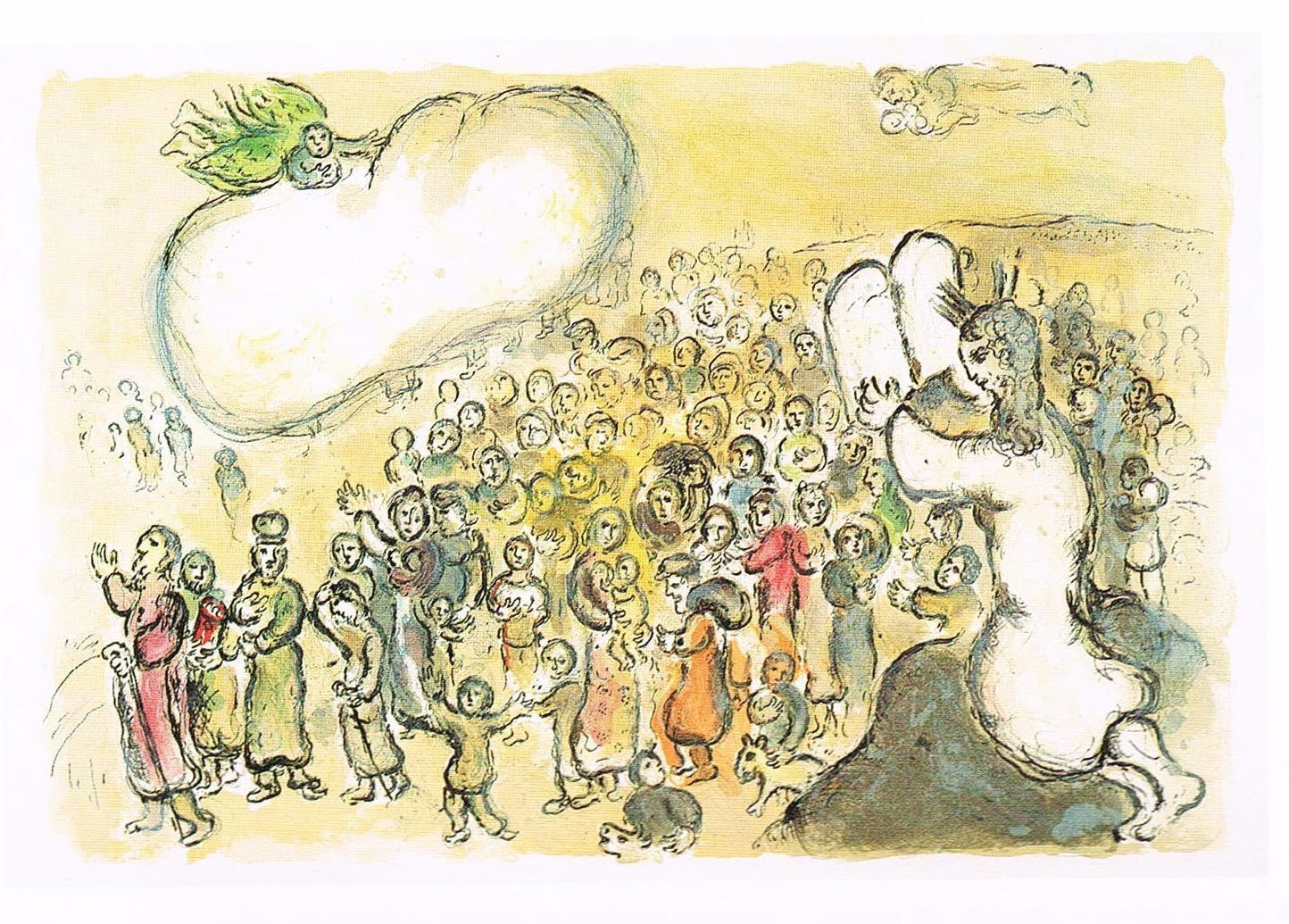
In this week’s parshah the Torah relates how “And all the people saw the voices and the torches” (Shemot 20:15). At first glance, this statement appears perplexing: voices, by their very nature, are heard, not seen. Rabbi Yishmael posits that the people experienced nature in its customary form—they beheld the visible lightning and heard the resonant thunder. Yet Rabbi Akiva presents an alternative understanding, one that suggests a radical inversion of the senses: the Israelites “saw what is normally heard” and “heard what is normally seen.” In this ecstatic state, the ordinary hierarchy between the physical and the spiritual was inverted. The normally intangible voice of G‑d became a clear vision, while the visual image of lightning faded into a distant sound.
This remarkable reordering of sensory experience serves as a metaphor for two models of divine service. The first model of Rabbi Yishmael is rooted in the conviction that sanctity is achieved by integrating the Divine into the world as it is. Here, the miracle of Sinai is appreciated in its most immediate form—the Almighty’s descent upon the mountain is a tangible event, witnessed through the ordinary operations of the human senses. In this view, holiness is not abstract or remote; rather, it is manifest in the very fabric of creation. The natural order is not negated but rather suffused with the presence of G‑d. The revelation is experienced as an invitation to sanctify the everyday—to recognise that the Divine, even when it appears in forms comprehensible to our limited perception, can elevate the mundane to the realm of the sacred. (For more on this model see last week’s essay ‘The Nature of Miracles’)
In contrast, the second model of divine service is marked by an aspiration to transcend the limitations imposed by material existence. This approach of Rabbi Akiva finds its expression in the radical sensory transformation at Sinai, where the Israelites did not merely observe the world as it is but reimagined it. To “see what is normally heard” is to experience the spiritual realm with the immediacy and certainty of vision, while “hearing what is normally seen” suggests that the normally perceptible physical dimension of the world is something we merely hear about as a vague possibility.
This difference of approach between Rabbi Yishmael and Rabbi Akiva is reflected in their interpretation of the seemingly superfluous ‘saying’ in the introductory verse of the Ten Commandments: “And G‑d spoke all these things, saying…” (Shemot 20:1). According to the Midrash, the word ‘saying’ indicates how the revelation at Sinai was not a unilateral decree but an interactive covenant: each commandment was met with a response—a resounding affirmation or negation. Rabbi Yishmael holds that the Israelites answered “yes” to the positive commandments and “no” to the negative ones, while Rabbi Akiva contends that they responded in the affirmative for both the positive and the negative commandments. These divergent responses are not arbitrary but illuminate their two distinct models of divine service—one that sanctifies the world as it is and another that strives to transcend its material limitations. Rabbi Yishmael, “who sees the ultimate achievement in translating G‑dliness into this world,” is conscious of the ways a positive command is distinguished from a negative one. Whereas for Rabbi Akiva, every element of a divine commandment—whether a directive to act or a prohibition against certain actions—is affirmed as an expression of an ultimate, transcendent will. Even what appears to be a negation, a command to refrain, is reinterpreted as a positive affirmation of the oneness and singularity of G‑d.
This dual framework resonates in the very structure of the commandments themselves. Each mitzvah, as presented in the Torah, carries a dual character. On one level, it is a specific directive aimed at particular behaviours and aspects of communal and personal life. On another level, however, it is an expression of the universal will of G‑d—a call that transcends the particulars and points toward an ultimate, unifying reality. The integrative model highlights the former, celebrating the diversity and concreteness of the world. The transcendental model, by contrast, illuminates the latter, revealing that even prohibitions, when understood in their deepest sense, can become vehicles for elevating the soul beyond its material confines.
The contrast between these two models is not merely theoretical but carries profound implications for the nature of divine service. The model that integrates the Divine into the world emphasises the immanence of holiness. It is a path suited to those who find their spiritual strength in engaging directly with the world’s tangible realities. Under this approach, the miraculous is not a departure from nature but its consummation; the Divine is brought down and revealed within the very confines of the natural order. This perspective encourages a mode of service that seeks to sanctify everyday life, transforming the ordinary into an expression of the sacred.
Conversely, the transcendental model calls for a radical reordering of perception. It is the pathway of the aspirant who, aware of the constraints of the material, endeavours to elevate the inner life beyond these bounds. In this vision, the sensory experience at Sinai becomes emblematic of an inner revolution—a reawakening of the soul to a reality that surpasses the physical. By affirming every commandment, regardless of its apparent negative or positive formulation, this model posits that every aspect of divine will contains within it the seed of transcendence.
The interplay between these two models, then, offers a comprehensive vision of divine service. On one hand, there is the grounded approach that invites one to see G‑d’s imprint on the world as it is, recognising that even the most ordinary aspects of creation are imbued with sacred potential. On the other hand, there is the visionary approach that challenges one to rise above the material, to internalise and transform one’s very modes of perception so that the boundary between the seen and the heard is effaced. The two models are not in opposition but are complementary; they reflect different aspects of a dynamic relationship with the Divine. The highest ideal, it seems, is not to choose one over the other but to integrate both: to aspire to an inner reality that transcends its limitations while also sanctifying the world as it is.
In reflecting on the Sinai revelation, we are thus invited to consider our own approach to divine service. It challenges us to recognise that the call to holiness is not a static command but a dynamic, multifaceted journey—one that asks us to both immerse ourselves in the world as it is and to elevate our inner life beyond its apparent confines. In light of the Rebbe’s interpretation, we can revisit Rabbi Sacks’ dichotomy of seeing and hearing. Rather than opposing forces, they can be seen as complementary dimensions of divine service—calling us to experience the Divine in all its paradoxical beauty: immanent and transcendent, visible and audible, grounded in the material yet soaring above it.